Unlocking a New Dimension in Unmanned Intelligence
Advanced gas analysis combining multi‑gas measurement and spectral fingerprinting enables new capabilities for safety monitoring, situational awareness, and unmanned intelligence in complex and dynamic environments.
Tunable’s gas analysis technology enables two complementary measurement approaches:
- Targeted measurements: Multi-gas analysis for known gases
- Gas Fingerprint Recognition: Full-spectrum sweeps used to identify combinations of gases by comparing spectral patterns to an established baseline

Feedback from Tunable’s customers shows that both approaches deliver value across a wide range of applications. In particular, combining data from these two modes opens new opportunities for deeper insight and more robust interpretation of complex gas environments.
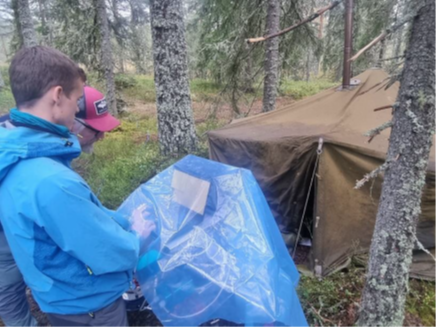
One application area of growing interest is the defense sector. The ability to monitor safety-related parameters during training exercises, combined with the potential to generate high-quality data for situational awareness and military intelligence, suggests that advanced gas analysis will become an essential capability. As part of this exploration, Tunable conducted an initial field test to evaluate whether the technology could distinguish between different environmental states during an infantry exercise.
Spectral sweeps were recorded under four distinct conditions:
- Reference sample: Ambient air measured outside the tent
- Tent interior (empty): Measurements taken with the probe inserted into the unoccupied tent
- Active heating source: One soldier entered the tent and ignited a Multifuel M94 heater
- Occupied environment: The remaining squad entered the tent, and measurements we rerecorded under realistic occupancy conditions
The results from these tests provide an early indication of how Tunable’s technology can differentiate between subtle changes in composition and activity, demonstrating its potential for both safety monitoring and tactical awareness.
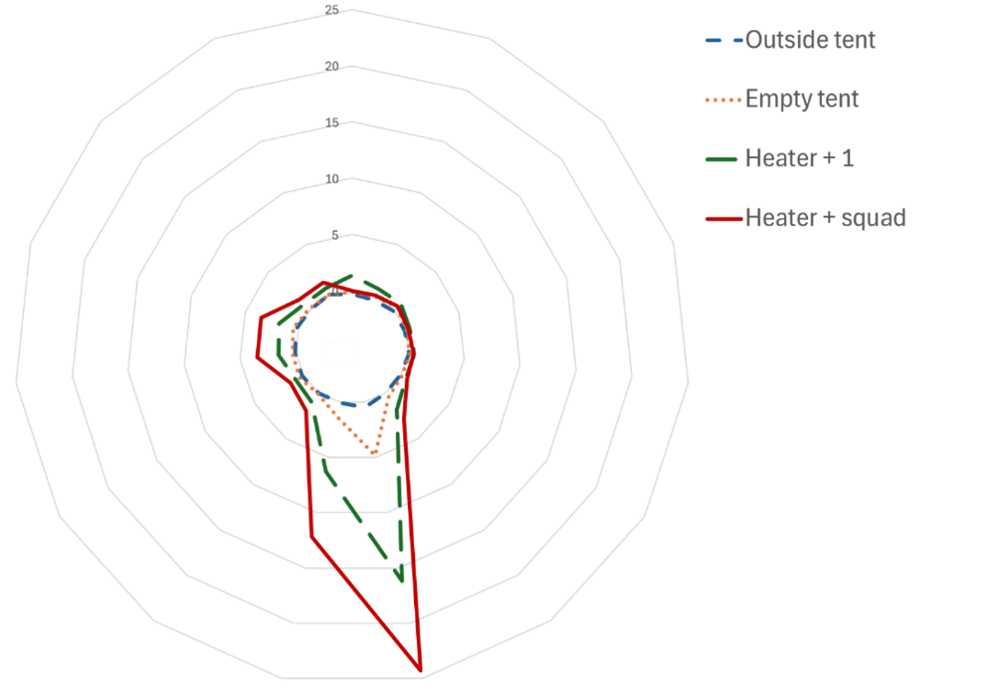
The measurements show distinct responses at different infrared wavelengths. The strongest signals occur at CO2 absorption bands, followed by notable changes in H2O and hydrocarbon regions.
Relevant application areas include personnel safety in confined environments (tents, vehicles, vessels) and monitoring of operational infrastructure such as mobile HQ units, field hospitals, fuel depots, and protected ammunition and storage facilities.
In combat scenarios, access to high-quality gas data can provide a valuable tactical edge. Assessing outposts or questioned areas to determine if enemy personnel are still present is one example. Similar approaches can be applied to differentiate between cleared and recently occupied spaces, detect hazardous buildup of gases in confined environments, or identify signatures from active equipment such as generators or vehicles.
One starting point for the defense industry is to use high-quality data to improve personnel safety. From there, the focus can expand to using gas data for situational awareness, supported by AI-based decision tools. Over time, a more advanced goal could be to equip drones, autonomous systems and humanoid robots with gas analysis capabilities, enabling them to operate in complex environments.
Interested to learn more?
Tunable needs the contact information you provide to us to contact you about our products and services. You may unsubscribe from these communications at any time. For information on how to unsubscribe, as well as our privacy practices and commitment to protecting your privacy, please review our Privacy Policy.